I’ve been playing around with an early version of Arroost, a node-based tool for live sampling.
New ways to do things
Since the days of soundtracking my own university lectures during Covid lockdowns, I have been quietly releasing music under the name “Curtsy Rehearsed”.
It was surprising to find that the music got the tiniest amount of local media attention in Summer 2022.
That encouraged me to take the music more seriously, which also made it less fun. I planned to sunset the Curtsy Rehearsed project, until I discovered Lu Wilson’s Arroost. Arroost unlocked music for me again and I’ve never stopped making music since.
- Dollops (August 2025)
- Formal Garden (July 2025)
- Cop Synths (July 2025)
- Tough Centras (June 2025)
- Leisure Sick (June 2025)
- Calmlies (April 2025)
- Laconics (April 2025)
- Mulcahy (March 2025)
- Newly Sincere (March 2024)
- Kinds of Summer (August 2024)
- Micro Noirs (October 2024)
- Micro Saliences (October 2024)
- Insistence (December 2024)
Arroost was a new way of making music for me. The process became more light and joyful than what had become painstaking, hours-long DAW sessions.
Arrows to sounds
Arroost consists of an infinite canvas on which nodes can be placed. When a newly placed node is clicked it starts to record. Make a sound then click the node again and the recording is complete. That node will now play the recording each time it is triggered.
There are also special nodes for controlling the Canvas. At time of writing, these control nodes (my term) include:
- Add: adds a node to the canvas
- Connect: connects two nodes
- Remove: removes a node or connection
- Annotate: adds text next to a block
Individual nodes can be connected through arrows. Nodes can be arranged in sequences using these arrows to create patterns. Given three nodes A, B and C, a loop can be created if there are the arrows A → B, B → C and C → A. Click a node in a loop and the loop will play continuously.
In the image below a loop can be seen connected by red arrows. Currently the bottom node in the loop is being triggered. This will be followed by the top-right node and so on.
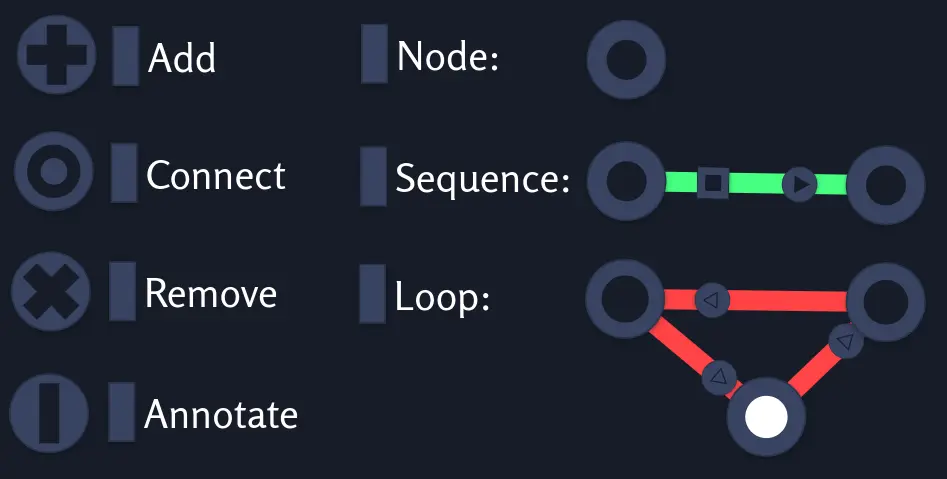 User interface of Arroost showing control nodes (Add, Connect, Remove and Annotate) and example sound structures (single node, node sequence, node loop).
There are some other nuances in the design: empty nodes can be used to create rests within sequences; the start time of a recorded sample can be offset; arrows can be coloured to control the flow of sounds. Many of these features can be discovered naturally through play.
The core of Arroost involves connecting nodes. This makes Arroost an easy and intuitive live-looper. By easy I mean relative to using a DAW like Reaper:
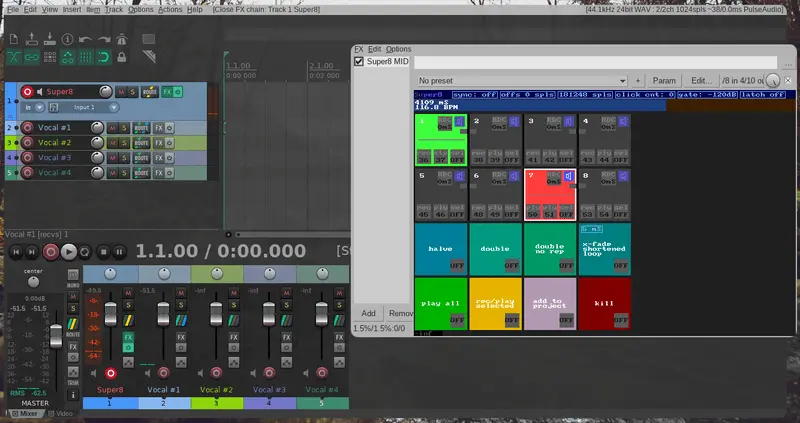 User interface of Reaper DAW with four vocal tracks routed into an instance of its Super8 looper. This works great but it takes some setting up and the interface is busy.
Despite its apparent simplicity, Arroost can be used to create some complex sounds. Only live vocal samples recorded into my microphone were used to create the following video, in which you can see the nodes and connections in action:
Becoming unlocked
Below is a short megamix “Leisure Sick” containing eight snippets of my Arroost experiments. I have high quality version of the full tracks as a private release on Bandcamp and you can contact me at edibotopic@gmail.com if you want a download code.
There are vocals strewn across all of my albums but usually as minor details and often warped beyond recognition. Arroost encouraged me to use more vocals through its
- Emphasis on live recording: it’s possible to do some pre-recorded sampling with Arroost; for example, you can change the audio input settings on your computer and record a drumbreak on YouTube. Arroost is configured, however, to use your default mic for live sampling. The most immediate recording option is to just sing, hum, chant, clap and bang. I could record 5 seconds of sounds with 4 dodgy seconds and then take the 1 second I liked for the rest of the song. It’s amazing how far this approach can take you as the connections build up.
- Limited control of mix quality: one of the factors that makes recording vocals difficult is the need for noise-reduction. Usually this requires recording some ambient noise and subtracting it from the recording. This needs continuous tweaking and can result in poor quality audio if you’re not in a good recording environment (I rarely am). With Arroost I couldn’t do noise reduction, so I stopped caring and just focused on recording.
- Coupling of audio and visuals: I normally make songs that are built from hundreds of samples and recordings. When people listen I sometimes get the impression that they don’t know exactly what I did — it’s a black box. Arroost generates a tightly-coupled combination of audio and visuals. Even if sharing a finished set of nodes and connections, there is an embedded performance. I probably couldn’t sing at your wedding but I can put vocal snippets together into an interesting structure — I think Arroost helps show this.
”Share scrappy fiddles”
Encouraged by the developer Lu Wilson’s call to
Normalise sharing scrappy fiddles
I shared my Arroost creations on a (now defunct) Mastodon account as short videos. All in all, I recorded about 60 minutes of music in three weeks. I stopped when Arroost simply became too addictive!
Lu is continuing to work on Arroost. From talking with them, the tool will likely evolve considerably. While writing this post I set up some basic nodes and connections in Arroost to grab a screenshot. Soon after I realised that arrows could now be coloured and that this affected the flow of sound!!! This arrow-colouring novelty immediately made me want to stop writing and start experimenting with Arroost again…
In its current state, Arroost is a great tool for rapidly iterating on song ideas. Although I didn’t use it when making the newest Curtsy Rehearsed projects I think Arroost got me back to a place where I could make something again.